Section 67.5: 迭代
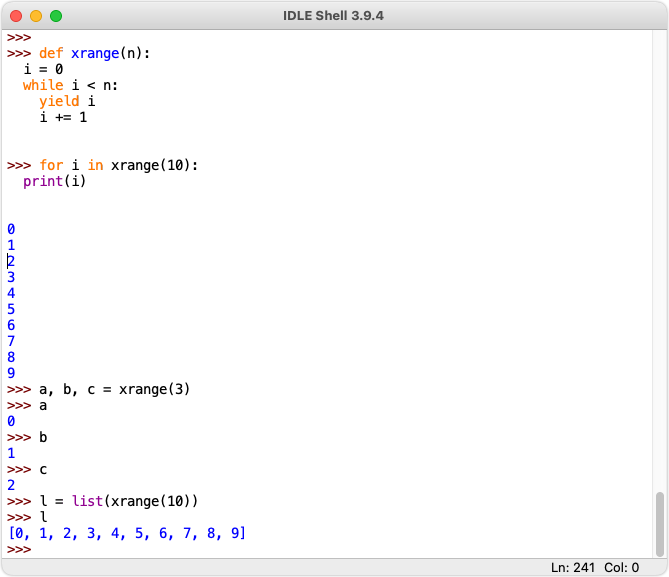
生成器对象支持迭代器协议。也就是说,它提供了一个 next() 方法 (在 Python 3.x 中为 __next__()),用来逐步执行它,而它的 __iter__ 方法返回它自己。这意味着生成器可以用于任何支持泛型可迭代对象的语言构造中。
# Python 2.x xrange() 的部分实现
def xrange(n):
  i = 0
  while i < n:
    yield i
    i += 1

# looping
for i in xrange(10):
  print(i) # prints the values 0, 1, ..., 9

# unpacking
a, b, c = xrange(3) # 0, 1, 2

# building a list
l = list(xrange(10)) # [0, 1, ..., 9]
Section 67.6: next() 函数
内置的 next() 是一个方便的封装器,可用于从任何迭代器(包括生成器迭代器)接收值,并在迭代器耗尽时提供默认值。
def nums():
  yield 1
  yield 2
  yield 3

generator = nums()

next(generator, None) # 1
next(generator, None) # 2
next(generator, None) # 3
next(generator, None) # None
next(generator, None) # None

# ...
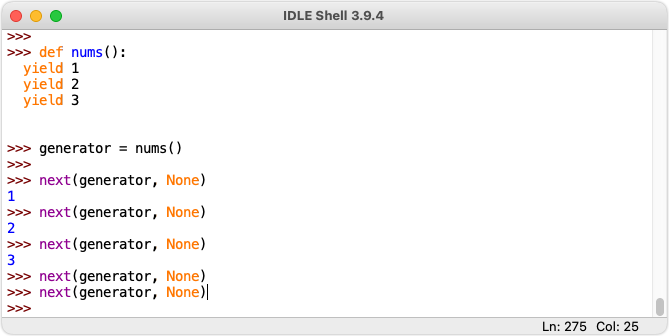
语法是 next(iterator[, default])。如果迭代器结束并传递了默认值,则返回该值。如果没有提供默认值,则会引发 StopIteration。
Section 67.7: 例程
生成器可用于实现例行程序:
# create and advance generator to the first yield
def coroutine(func):
  def start(*args,**kwargs):
    cr = func(*args,**kwargs)
    next(cr)
    return cr
  return start

# example coroutine
@coroutine
def adder(sum = 0):
  while True:
    x = yield sum
    sum += x

# example use
s = adder()
s.send(1) # 1
s.send(2) # 3
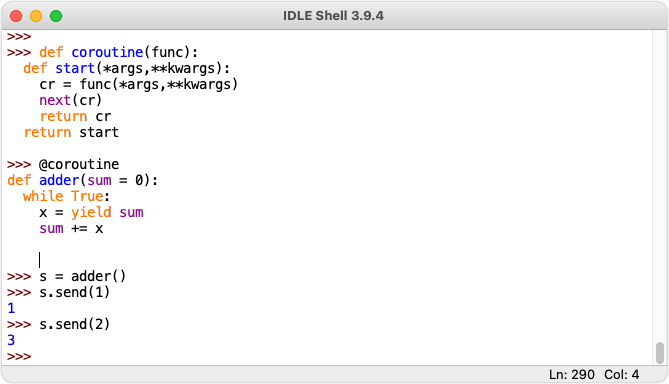
例程通常用于实现状态机,因为它们主要用于创建需要状态才能正常运行的单方法程序。它们对现有状态进行操作,并返回操作完成后获得的值。
Section 67.8: Refactoring list-building code
重构列表构建代码
def create():
  result = []
  # logic here...
  result.append(value) # possibly in several places
  # more logic...
  return result # possibly in several places

values = create()
当用列表理解替换内部逻辑不现实时,可以将整个函数就地转化为生成器,然后收集结果:
def create_gen():
  # logic...
  yield value
  # more logic
  return # not needed if at the end of the function, of course

values = list(create_gen())
如果逻辑是递归的,则使用 yield from 在 "扁平化" 结果中包含递归调用的所有值:
def preorder_traversal(node):
  yield node.value
  for child in node.children:
    yield from preorder_traversal(child)
Section 67.9: 递归:递归列出目录中的所有文件
首先,导入处理文件的库:
from os import listdir
from os.path import isfile, join, exists
只读取目录中文件的辅助函数:
def get_files(path):
  for file in listdir(path):
    full_path = join(path, file)
    if isfile(full_path):
      if exists(full_path):
        yield full_path
另一个只获取子目录的辅助函数:
def get_directories(path):
  for directory in listdir(path):
    full_path = join(path, directory)
    if not isfile(full_path):
      if exists(full_path):
        yield full_path
现在,使用这些函数递归获取一个目录及其所有子目录中的所有文件(使用生成器):
def get_files_recursive(directory):
  for file in get_files(directory):
    yield file
  for subdirectory in get_directories(directory):
    for file in get_files_recursive(subdirectory): # here the recursive call
      yield file
这个函数可以通过以下方法简化:
def get_files_recursive(directory):
  yield from get_files(directory)
  for subdirectory in get_directories(directory):
    yield from get_files_recursive(subdirectory)
Section 67.10: 生成器表达式
可以使用类似于理解的语法创建生成器迭代器。
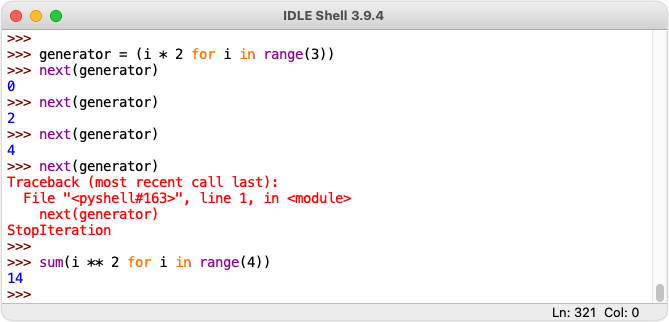
generator = (i * 2 for i in range(3))
next(generator) # 0
next(generator) # 2
next(generator) # 4
next(generator) # raises StopIteration
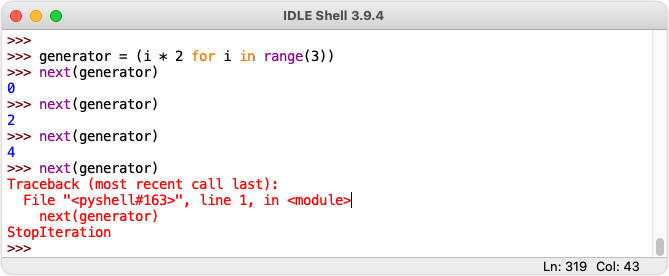
如果函数不一定需要传递一个列表,那么可以通过在函数调用中加入一个生成器表达式来节省字符(并提高可读性)。函数调用中的括号会隐含地使您的表达式成为一个生成器表达式。
sum(i ** 2 for i in range(4)) # 0^2 + 1^2 + 2^2 + 3^2 = 0 + 1 + 4 + 9 = 14
此外,您还可以节省内存,因为生成器允许 Python 根据需要使用值,而不是加载您要遍历的整个列表(上例中的[0, 1, 2, 3])。
Section 67.11: 使用生成器查找斐波那契数
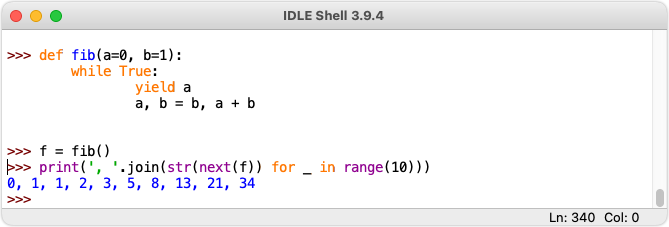
生成器的一个实际用例是遍历无穷级数的值。下面是一个查找斐波那契数列前十项的例子。
def fib(a=0, b=1):
  """Generator that yields Fibonacci numbers. `a` and `b` are the seed values"""
  while True:
    yield a
    a, b = b, a + b

f = fib()
print(', '.join(str(next(f)) for _ in range(10)))
# Outputs: 0, 1, 1, 2, 3, 5, 8, 13, 21, 34
Section 67.12: 搜索
即使不进行迭代,next 函数也很有用。向 next 传递一个生成器表达式,可以快速搜索与某个谓词匹配的元素的首次出现。程序代码如
def find_and_transform(sequence, predicate, func):
  for element in sequence:
    if predicate(element):
      return func(element)
    raise ValueError

item = find_and_transform(my_sequence, my_predicate, my_func)
可以替换为
item = next(my_func(x) for x in my_sequence if my_predicate(x))
# 如果没有匹配结果,将引发 StopIteration;如果需要,可以捕获并转换此异常。
为此,最好创建一个别名(如 first = next)或一个封装函数来转换异常:
def first(generator):
  try:
    return next(generator)
  except StopIteration:
    raise ValueError
Section 67.13: 并行迭代生成器
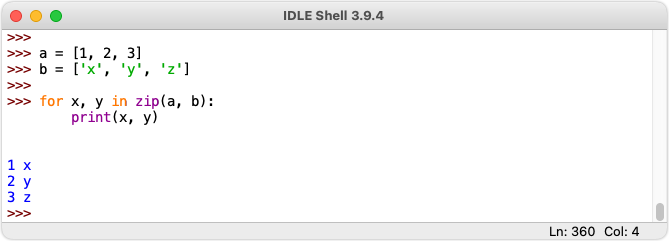
要并行遍历多个生成器,请使用 zip 内置函数:
for x, y in zip(a,b):
  print(x,y)
结果是
1 x
2 y
3 z
在 python 2 中,应使用 itertools.izip 代替。在这里,我们还可以看到所有 zip 函数都会产生元组。
请注意,一旦其中一个迭代项耗尽,zip 就会停止迭代。如果你想迭代最长的迭代项,请使用 itertools.zip_longest()。


